

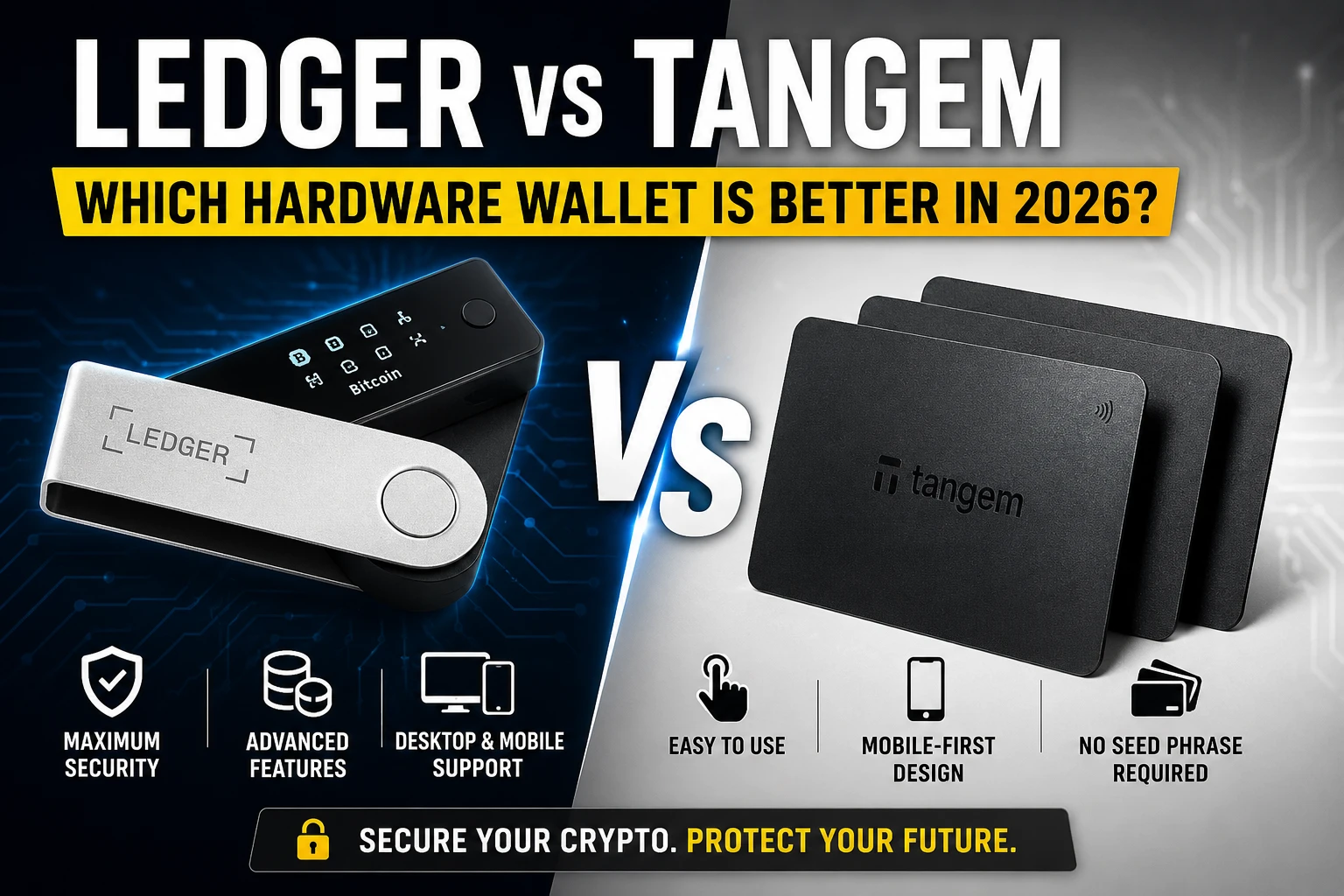
Ledger vs Tangem: Which Hardware Wallet Is Better in 2026?
If you keep crypto on an exchange, you do not fully control your assets.
That reality has become painfully clear after multiple exchange failures, phishing attacks, account freezes, and security breaches over the past few years.
Hardware wallets help solve that problem by moving your crypto into cold storage where you control the private keys.
Two of the most popular options in 2026 are Ledger and Tangem.
Both are designed to help investors secure Bitcoin, Ethereum, XRP, Solana, and other crypto assets away from centralized exchanges.
But which hardware wallet is actually better for your situation?
This guide compares:
- Security
- Convenience
- Ease of use
- Staking support
- Backup systems
- Supported cryptocurrencies
- Mobile experience
- Long-term reliability
so you can choose the best hardware wallet for protecting your crypto in 2026.
Many investors now combine hardware wallets with staking strategies to improve both security and long-term yield generation.
Ledger vs Tangem Quick Comparison
| Feature | Ledger | Tangem |
|---|---|---|
| Best For | Advanced users & long-term investors | Beginners & convenience |
| Ease of Use | Moderate | Very Easy |
| Convenience | Good | Excellent |
| Mobile Experience | Strong | Excellent |
| Desktop Support | Yes | Limited |
| Seed Phrase Required | Yes | Optional |
| NFC Tap Support | No | Yes |
| Staking Support | Strong | Moderate |
| DeFi Compatibility | Extensive | Basic to Moderate |
| Backup Method | Recovery phrase | Backup cards |
| Security Level | Excellent | Excellent |
| Best Choice For Simplicity | Good | Excellent |
Best Wallet by User Type
Choose Ledger if you:
- Want advanced control and security options
- Use DeFi, staking, or multiple chains
- Prefer desktop + mobile flexibility
- Hold larger long-term crypto positions
Choose Tangem if you:
- Want maximum convenience
- Prefer mobile-first crypto management
- Do not want to manage seed phrases
- Want the fastest path into cold storage
Ready to Move Your Crypto Off Exchanges?
Protecting your assets with a hardware wallet is one of the most important steps long-term crypto investors can take.
What Is a Hardware Wallet?
A hardware wallet (also called a cold wallet or cold storage wallet) stores your crypto private keys offline.
That means hackers cannot remotely access your funds the same way they potentially can with:
- Exchange accounts
- Browser wallets
- Hot wallets
- Cloud-based storage
For long-term crypto investors, hardware wallets are one of the safest ways to protect digital assets.
This becomes especially important during:
- Bull markets
- Exchange instability
- Increased phishing attacks
- Long-term Bitcoin and Ethereum accumulation
Ledger Security Overview
Ledger
uses secure element chips similar to those used in passports and banking systems.
Ledger wallets generate a recovery seed phrase that lets users restore access if the device is lost, stolen, or damaged.
Ledger Pros
- Industry-standard cold storage security
- Large ecosystem support
- Strong staking integrations
- Desktop and mobile support
- Advanced passphrase functionality
Ledger Cons
- Slightly more complex setup process
- Requires careful seed phrase management
- May feel intimidating for complete beginners
Ledger is often preferred by:
- Long-term Bitcoin holders
- DeFi users
- Advanced crypto investors
- Users managing larger portfolios
Tangem Security Overview
Tangem
takes a very different approach.
Instead of requiring users to manually manage a traditional recovery phrase, Tangem uses NFC-enabled backup cards that pair with a smartphone app.
This dramatically simplifies onboarding for newer crypto users.
Tangem Pros
- Extremely simple setup
- Excellent convenience
- Mobile-first experience
- No traditional seed phrase required
- Fast cold storage onboarding
Tangem Cons
- Less advanced flexibility for power users
- Smaller ecosystem than Ledger
- More limited desktop workflow support
Tangem is often preferred by:
- Beginners
- Mobile-focused users
- Investors wanting simple cold storage
- Users intimidated by seed phrases
Which Hardware Wallet Is Easier to Use?
For most beginners, Tangem is easier.
The wallet works through NFC tap cards and a smartphone app. There are no USB cables, desktop software installs, or complicated onboarding steps.
Ledger is still beginner-friendly, but it feels more like a traditional security device.
If your priority is:
- Convenience
- Simplicity
- Speed
- Mobile-first usability
Tangem may feel significantly easier.
If your priority is:
- Maximum control
- Advanced security
- Staking integrations
- DeFi compatibility
Ledger usually has the advantage.
Ledger vs Tangem Supported Coins
Both wallets support major cryptocurrencies including:
- Bitcoin (BTC)
- Ethereum (ETH)
- XRP
- Solana (SOL)
- USDT
- Cardano (ADA)
However, Ledger generally supports:
- More total cryptocurrencies
- More staking integrations
- More third-party wallet compatibility
- Broader DeFi ecosystem support
Tangem focuses more heavily on:
- Mainstream crypto assets
- Simplicity
- Mobile usability
Staking Support
Many investors now want hardware wallets that also support staking.
Ledger integrates with several staking ecosystems directly or through supported applications including:
- Ethereum staking
- Solana staking
- Cardano staking
- Polkadot staking
Tangem also supports staking for selected assets through its mobile ecosystem.
If staking flexibility matters heavily to you, Ledger currently offers the stronger ecosystem overall.
If you are researching passive income opportunities, you can also compare current crypto staking rates across exchanges and platforms.
Price Comparison
Tangem is often cheaper and simpler.
Ledger devices vary depending on features and hardware model:
- Ledger Nano S Plus
- Ledger Nano X
- Ledger Stax
Tangem generally appeals more to users looking for:
- Affordable cold storage
- Simple backups
- Fast setup
- Maximum convenience
Ledger appeals more to users looking for:
- Long-term portfolio management
- Advanced security flexibility
- Broader ecosystem compatibility
- Multi-device workflows
Who Should Buy Ledger?
Ledger is probably the better choice if:
- You hold significant crypto value
- You use DeFi regularly
- You stake multiple assets
- You want advanced security controls
- You want maximum ecosystem support
Who Should Buy Tangem?
Tangem is probably the better choice if:
- You are new to self-custody
- You want maximum convenience
- You mainly use mobile devices
- You dislike managing seed phrases
- You want the fastest path into cold storage
Hardware Wallets vs Leaving Crypto on Exchanges
Leaving crypto on exchanges may feel convenient, but it also introduces:
- Counterparty risk
- Account freezes
- Platform insolvency risk
- Hacking exposure
- Withdrawal restrictions
Hardware wallets help reduce those risks because you directly control your private keys.
For a deeper breakdown of self-custody risks and exchange exposure, see our guide on:
Final Thoughts
The best hardware wallet is the one you will actually use consistently.
Many crypto investors delay moving assets into cold storage because they assume hardware wallets are complicated.
That delay can become expensive.
If you want:
- Maximum convenience → Tangem is excellent
- Advanced flexibility and ecosystem depth → Ledger remains one of the strongest choices in crypto
Either option is significantly safer than leaving long-term holdings exposed on centralized exchanges.
You can also compare additional cold storage options in our:
Additional Resources
You may also find these guides useful:
Written by T.K.
About the Author
T.K. maintains and operates StakingCrypto.io, including its automated platform for tracking more than 589 staking and yield rates across 35 exchanges. With more than a decade of experience in IT, systems engineering, and following the cryptocurrency industry, he combines technical expertise with years of studying investing, blockchain technology, and digital assets. Drawing on experience building systems, software, AI, operating businesses, and using staking and yield products firsthand, his goal is to share practical knowledge that helps readers save time, reduce research, and make more informed comparisons through transparent data and straightforward educational content.